Minnesota minimum wage: $11.41 an hour, rising to $11.87 on January 1, 2027
Checked November 7, 2026Source: Minnesota Department of Labor and Industry
Some cities in Minnesota require more. See city rates
Short answer
Minnesota’s minimum wage is $11.41 an hour, in effect since January 1, 2026, according to the Minnesota Department of Labor and Industry.
Tipped employees must be paid the full minimum wage in cash; Minnesota doesn’t let employers count tips toward it.
It rises to $11.87 on January 1, 2027.
Some Minnesota cities require more: Minneapolis $16.37 an hour and St. Paul $14.25 to $16.37 by employer.
Get Minnesota rate alerts
One email when a rate, a law or a deadline changes. Free. Privacy.
- Minimum wage today
- $11.41
- From January 1, 2027
- $11.87
- Full-time year at today’s rate (2,080 hours)
- $23,733
Cities and counties can require more. Minneapolis and St. Paul set their own higher rates.
City rates in Minnesota
Read from each government source on November 8, 2026. Where a place sets different rates by employer, each gets its own line.
| Place | Rate now | Next rate and date | Who it covers |
|---|---|---|---|
| Minneapolis | $16.37 | $17.02on January 1, 2027 | Work performed inside the city, for any employee who works at least 2 hours in a calendar week in Minneapolis, regardless of employer size or location.Source: City of Minneapolis |
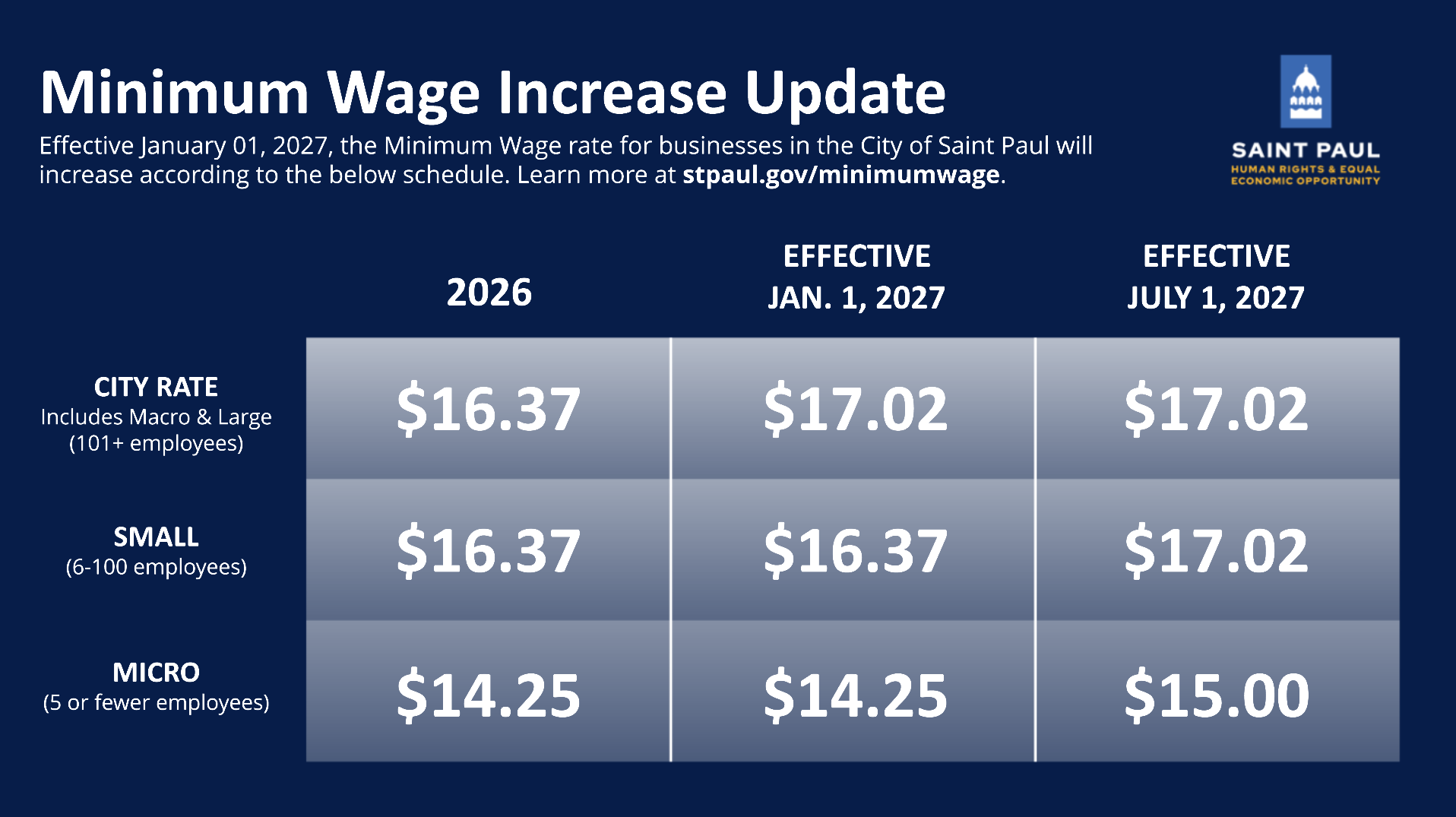
| St. PaulMacro (10,001 or more employees) and City of Saint Paul | $16.37 | $17.02on January 1, 2027 | All hours worked within St. Paul city limits, including full-time, part-time and temporary employees.Sources: City of Saint Paul, Human Rights and Equal Economic Opportunity, City of Saint Paul |
| St. PaulLarge (101 to 10,000 employees) | $16.37 | $17.02on January 1, 2027 | |
| St. PaulSmall (6 to 100 employees) | $16.37 | $17.02on July 1, 2027 | |
| St. PaulMicro (5 or fewer employees) | $14.25 | $15.00on July 1, 2027 |
What the January 1, 2027 raise costs you
The raise is $0.46 an hour for anyone paid less than the new rate on January 1, 2027.
- Added wages a year
- $718
- Employer Social Security and Medicare (FICA), 7.65%
- $55
- Total added cost a year
- $773
Counts only the raise for workers below the new rate, over 52 weeks. It leaves out raises you give others to keep pay gaps, and state unemployment tax, which usually stops at a wage cap.
Minnesota minimum wage by date
| Effective | Minimum wage | Note |
|---|---|---|
| January 1, 2027Upcoming | $11.87 | Announced August 19, 2026 (3.99% inflation adjustment).source |
| January 1, 2026Current | $11.41 | One rate for all employers. No tip credit.source |
| January 1, 2025 | $11.13 | source |
Adjusted every January 1 for inflation (PCE implicit price deflator), capped at 5%; the commissioner sets it by August 31.
Other Minnesota rates
90-day training wage
Workers under 20 during their first 90 consecutive days with the employer.
Today: $9.31 · from January 1, 2027: $9.68
Before January 1, 2027
- Update every hourly rate below $11.87 in payroll so the first paycheck on or after that date is right.
- Replace the minimum wage poster with the new year’s version from the Minnesota Department of Labor and Industry.
Other Minnesota pay rules
- Paydays
- At least once every 31 days on a regular payday.
- Overtime
- Overtime after 48 hours in a week under state law. Employers covered by the federal Fair Labor Standards Act (FLSA) must pay overtime after 40 hours.
- Final paycheck
- Fired: Within 24 hours of the employee’s demand for wages; without a demand, generally by the regular payday. In some circumstances, final wages are due within 24 hours without a demand. Quit: By the next regular payday. If that payday is within 5 days of the last day, by the following payday, but no later than 20 days after leaving.
From the Minnesota Department of Labor and Industry and the U.S. Department of Labor’s state tables. All Minnesota employer rules.
Minimum wage in states next to Minnesota
If you hire across a state line, the worker’s state sets the rate.
| State | Today | Next change |
|---|---|---|
| Minnesota | $11.41 | $11.87 on January 1, 2027 |
| South Dakota | $11.85 | $12.30 on January 1, 2027 |
| Iowa | $7.25 | None scheduled |
| North Dakota | $7.25 | None scheduled |
| Wisconsin | $7.25 | None scheduled |
Questions employers ask
What is the minimum wage in Minnesota in 2026?
Minnesota’s minimum wage is $11.41 an hour, in effect since January 1, 2026, according to the Minnesota Department of Labor and Industry.
What is the tipped minimum wage in Minnesota?
Tipped employees must be paid the full minimum wage in cash; Minnesota doesn’t let employers count tips toward it.
When does the Minnesota minimum wage go up next?
On January 1, 2027, to $11.87 an hour. Adjusted every January 1 for inflation (PCE implicit price deflator), capped at 5%; the commissioner sets it by August 31.
Do cities in Minnesota have a higher minimum wage?
Yes. Minneapolis and St. Paul set their own higher rates. Today’s local rates: Minneapolis $16.37 an hour and St. Paul $14.25 to $16.37 by employer.
Does Minnesota require overtime pay?
Overtime after 48 hours in a week under state law. Employers covered by the federal Fair Labor Standards Act (FLSA) must pay overtime after 40 hours.
Compare every state’s minimum wage · Everything employers in Minnesota must do
Sources
- Minnesota Department of Labor and Industry
- Minimum-wage rate adjusted for inflation as of Jan. 1, 2027, Minnesota Department of Labor and Industry (read Nov 7, 2026)
- New minimum-wage rates, changes to meal and rest break laws take effect Jan. 1, 2026, Minnesota Department of Labor and Industry (read Nov 7, 2026)
- Minnesota Statutes section 177.24, Payment of minimum wages, Minnesota Office of the Revisor of Statutes (read Nov 7, 2026)
- Minneapolis Minimum Wage, City of Minneapolis (read Nov 8, 2026)
- Minimum Wage, City of Saint Paul, Human Rights and Equal Economic Opportunity (read Nov 8, 2026)
- Minimum Wage Increase Update chart (September 2026), City of Saint Paul (read Nov 8, 2026)