How to hire your first employee: the steps, forms and deadlines
Checked November 9, 2026From the IRS, USCIS, the Department of Labor and each state’s agencies
Short answer
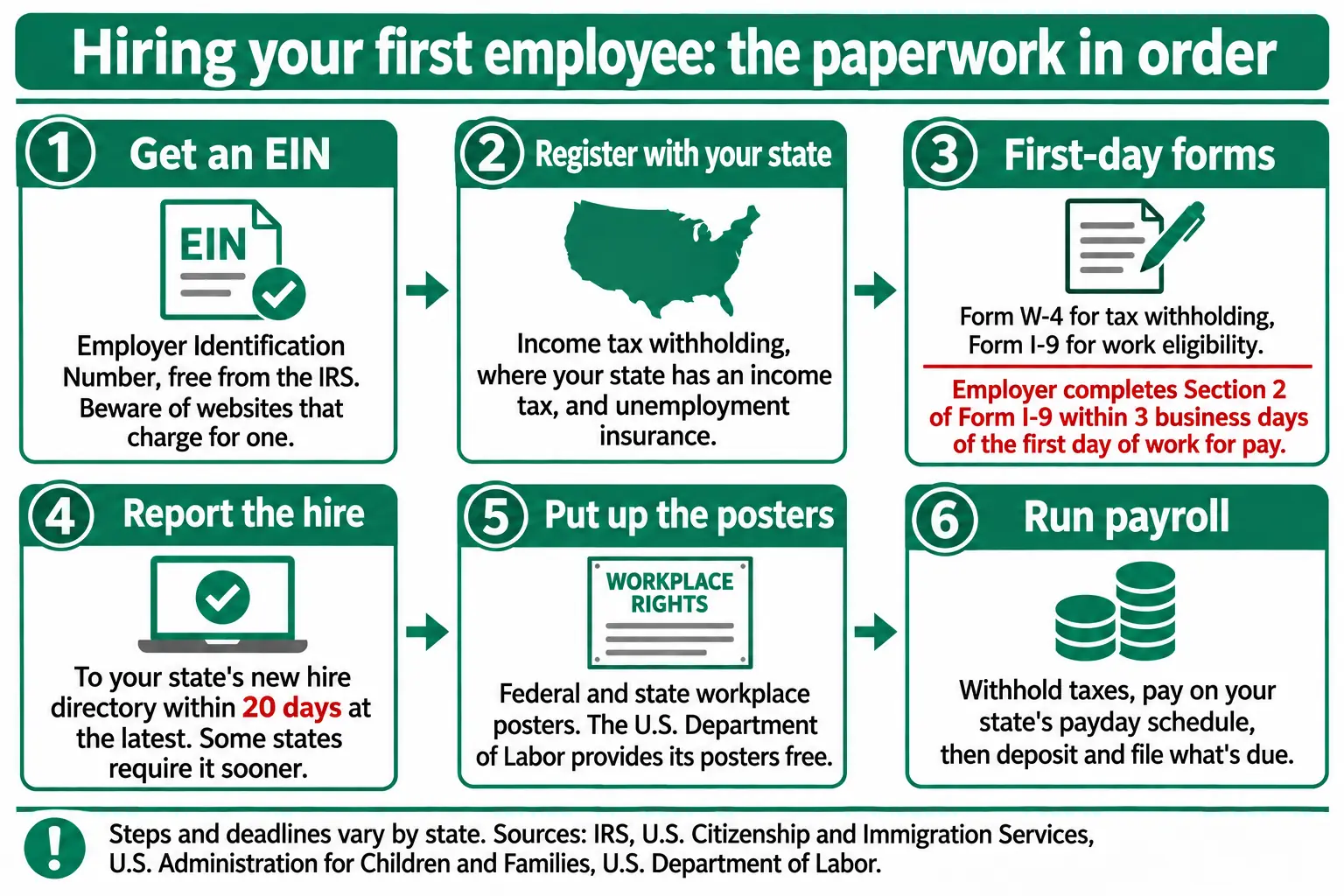
To hire a first employee, a U.S. business gets a free Employer Identification Number (EIN) from the IRS, registers for its state’s payroll taxes, and has the employee complete Form W-4 and Form I-9.
The employer finishes its part of Form I-9 within 3 business days of the first day of work and reports the hire to the state within 20 days, or sooner where the state sets a shorter deadline.
From the first paycheck the employer withholds federal income tax plus 7.65% of wages for Social Security and Medicare, pays a matching 7.65%, and deposits all of it with the IRS.
Get deadline alerts for your state
One email when a rate, a law or a deadline changes. Free. Privacy.
What are the steps to hire a first employee?
These are the federal steps. Your state adds its own, listed in the table further down. Running the business under your own name? See whether a sole proprietor can have employees.
Get an Employer Identification Number (EIN)
Free
An Employer Identification Number (EIN) is the tax ID number the IRS gives a business, and the IRS says you need one if you have employees. Its online application is free, and the number is issued as soon as the application is approved. The IRS warns against websites that charge for an EIN, because you never have to pay for one. If you’re setting up an LLC or a corporation, the IRS says to form it with your state first and then apply.
Register for your state’s payroll taxes
States collect their own payroll taxes, and each has its own sign-up. The Small Business Administration (SBA) lists this in its payroll steps as finding out whether you need state or local tax IDs. It adds that unemployment insurance varies by state and may mean registering with your state’s workforce agency. The IRS links to every state’s site for employers, and the Department of Labor lists each state’s unemployment tax office.
Every state’s site, from the IRS · State unemployment tax offices, from the Department of Labor
Have the employee fill out Form W-4
When they start work
Form W-4 tells you how much federal income tax to withhold from the employee’s pay. The IRS says to ask every new employee for a signed one when they start work and to use it from the first wage payment. If an employee doesn’t give you one, the IRS says to withhold as if the employee is single. You also need the employee’s name and Social Security number, which go on the Form W-2 at the end of the year.
Complete Form I-9
Within 3 business days of the first day of work
Form I-9 is how an employer verifies that a new hire is who they say they are and is allowed to work in the United States. The IRS says every U.S. employer must complete one for every person hired, citizens and noncitizens alike. The employee fills in Section 1 no later than the first day of work for pay. You, or someone you authorize, complete and sign Section 2 within 3 business days of that first day, according to U.S. Citizenship and Immigration Services (USCIS).
Report the new hire to your state
Within 20 days of hire, or sooner where the state says so
Federal law requires employers to report each new or rehired employee to the state where the employee works within 20 days of hire, and some states require it sooner. The report has 7 items: the employee’s name, address, Social Security number and date of hire, and the employer’s name, address and federal Employer Identification Number. States pass the reports to a national directory that child support agencies use. The state table on this page gives each state’s deadline and where to send the report.
New hire reporting, from the Administration for Children and Families
Check your state’s workers’ compensation rule
The SBA lists workers’ compensation among the benefits employers are required to provide, through a commercial insurance carrier, by self-insuring, or through a state workers’ compensation program. What’s required varies by state. The Department of Labor links to every state’s workers’ compensation office.
State workers’ compensation offices, from the Department of Labor
Put up the required workplace posters
Free from the Department of Labor
Some federal labor laws require employers to post notices in the workplace, and which ones apply depends on the business. The Department of Labor gives the posters away as free downloads, and its elaws Poster Advisor works out which ones you’re required to display. State posters are separate and come from each state’s labor department.
Withhold and deposit payroll taxes from the first paycheck
Each payday you withhold federal income tax and the employee’s share of Social Security and Medicare, and you owe a matching employer share. The IRS requires the deposits to be made electronically, on a monthly or semiweekly schedule that IRS Publication 15 tells you how to determine before each calendar year. Paying through an IRS business tax account, Direct Pay for businesses or the Electronic Federal Tax Payment System (EFTPS) is free. Federal unemployment tax is the employer’s alone and is never withheld from pay. It’s deposited once the amount due passes $500, by the end of the month after the quarter.
File Form 941 each quarter, and Forms W-2 and 940 each January
April 30, July 31, October 31 and January 31
Form 941 reports the wages you paid and the income tax, Social Security and Medicare tax on them. The IRS wants it by the last day of the month after each quarter ends. Once a year, by January 31, you give each employee a Form W-2, file the W-2s with the Social Security Administration, and file Form 940 for federal unemployment tax. A due date that lands on a weekend or legal holiday moves to the next business day.
What does an employee cost beyond wages?
- Social Security, employer share
- 6.2% of wages up to $184,500 in 2026. Details
- Medicare, employer share
- 1.45% of all wages
- Federal unemployment tax
- 6% of the first $7,000 of each employee’s pay, before a credit most employers get for paying state unemployment tax on time. Details
- State unemployment tax
- At a rate your state sets
- Workers’ compensation insurance
- Where your state requires it
- State paid leave premium
- In states with a program; the state table names them
An example, not an average: for one full-time employee at $20 an hour ($41,600 a year), the employer’s share of Social Security and Medicare is $3,182 a year. The employee pays the same amount through withholding.
Can you run payroll yourself?
The free route: do it yourself
Yes. Every step above can be done directly with the IRS and your state. The IRS’s own payment systems are free, and Form 941 can be filed on paper or electronically. It means working out each paycheck’s withholding, making the deposits on schedule and filing the returns yourself.
Payroll systems that say they file the taxes for you
| System and its lowest plan that files payroll taxes | One employee, a month | What its page says | Link |
|---|---|---|---|
| ADP RUNPrice not published; quoted by request | n/a | ADP’s RUN product page says RUN calculates payroll taxes automatically and can file federal, state and local payroll taxes for you with proper authorization. Their page, Nov 9, 2026 | See plans for ADP RUN |
| GustoSimple: $49 plus $7 per person | $56 | Gusto’s pricing page lists tax filings and payments on all three plans. Their page, Nov 9, 2026 | See plans for Gusto |
| OnPayPayroll Essentials: $49 plus $6 per worker | $55 | OnPay’s pricing page says federal, state and local tax filings are included. Their page, Nov 9, 2026 | See plans for OnPay |
| Patriot SoftwareFull Service Payroll: $37 plus $5 per worker paid | $42 | Patriot’s pricing page lists federal, state and local tax filings and deposits on Full Service Payroll, as additions to Basic Payroll. Their page, Nov 9, 2026 | See plans for Patriot Software |
| Paychex FlexPrice not published; quoted by request | n/a | Paychex’s small business payroll page says it calculates, withholds and files federal, state and local payroll taxes. Their page, Nov 9, 2026 | See plans for Paychex Flex |
| QuickBooks PayrollWorkforce Payroll: $50 plus $7 per employee | $57 | QuickBooks’ pricing page lists full service payroll on all three Workforce plans and says payroll taxes are done for you. Their page, Nov 9, 2026 | See plans for QuickBooks Payroll |
| RipplingPrice not published; quoted by request | n/a | Rippling’s payroll page says it automatically calculates payroll taxes and files them with the correct federal, state and local agencies. Their page, Nov 10, 2026 | See plans for Rippling |
| Square PayrollFull-service payroll: $35 plus $6 per person paid | $41 | Square’s pricing page says full-service payroll calculates, withholds and files federal payroll taxes, and pays and files the taxes in each state or tax jurisdiction where you run payroll. Their page, Nov 9, 2026 | See plans for Square Payroll |
Listed alphabetically, and only where the company’s own page says it files payroll taxes. List prices before discounts and add-ons; the one-employee figure is our arithmetic. We may earn a commission from these links; it never decides who’s listed. How we make money.
What does your state add?
Every state has its own new hire reporting address and deadline, and 31 of the 51 listed here set a minimum wage above the federal one. 13 state paid leave programs and 15 state retirement mandates are in effect, and where one applies it runs through payroll. Each state’s page has the rest: paydays, final paychecks, breaks and overtime.
New hire deadlines and addresses are from each state’s own new hire site, read on the date shown on that state’s page.
Questions employers ask
Do I need an Employer Identification Number (EIN) to hire one employee?
Yes. The IRS says you need an Employer Identification Number (EIN) if you have employees. Applying online at IRS.gov is free, and the IRS issues the number as soon as it approves the application.
Do I need an LLC to hire an employee?
Nothing in these steps requires one. The IRS’s page for sole proprietors, people who own an unincorporated business by themselves, lists the payroll tax returns (Forms 941 and 940) and Form W-2 among the forms a sole proprietor may need to file. If you do form an LLC or a corporation, the IRS says to form it with your state before you apply for an Employer Identification Number (EIN).
How long do I have to report a new hire?
Federal law gives employers 20 days from the date of hire to report a new or rehired employee to the state where the employee works, and some states set a shorter deadline, according to the federal Administration for Children and Families.
What forms does a new employee fill out?
Two federal forms. Form W-4 tells the employer how much federal income tax to withhold, and the IRS says to collect a signed one when the employee starts work. Form I-9 verifies identity and permission to work: the employee completes Section 1 no later than the first day of work, and the employer completes Section 2 within 3 business days of that day.
When are payroll taxes due?
Deposits of withheld income tax, Social Security and Medicare tax follow a monthly or semiweekly schedule, which the IRS has employers determine before each calendar year. Form 941 is due by the last day of the month after each quarter: April 30, July 31, October 31 and January 31. Forms W-2 and Form 940 are due by January 31.
Do I have to use a payroll service?
No. The IRS lets employers make payroll tax deposits themselves, free, through an IRS business tax account, Direct Pay for businesses or the Electronic Federal Tax Payment System (EFTPS), and file Form 941 on paper or electronically. It notes that a payroll service or tax professional can make the payments for you and may charge a fee.
What does an employee cost beyond wages?
On top of wages, an employer pays 7.65% for Social Security and Medicare (the Social Security part stops at $184,500 of pay in 2026), federal unemployment tax of 6% on the first $7,000 of each employee’s pay before a credit most employers get, state unemployment tax at a rate the state sets, and workers’ compensation insurance where the state requires it. For a full-time employee at $20 an hour, the Social Security and Medicare share alone is $3,182 a year.
Employer requirements in every state · Federal rules and deadlines · Deadline calendar
Sources
- Get an employer identification number, Internal Revenue Service (read Nov 9, 2026)
- Employer identification number: who needs an EIN, Internal Revenue Service (read Nov 9, 2026)
- Sole proprietorships, Internal Revenue Service (read Nov 9, 2026)
- Hiring employees, Internal Revenue Service (read Nov 9, 2026)
- Depositing and reporting employment taxes, Internal Revenue Service (read Nov 9, 2026)
- Employment tax due dates, Internal Revenue Service (read Nov 9, 2026)
- State government websites, Internal Revenue Service (read Nov 9, 2026)
- Completing Section 1, Employee Information and Attestation, U.S. Citizenship and Immigration Services (read Nov 9, 2026)
- Completing Section 2, Employer Review and Attestation, U.S. Citizenship and Immigration Services (read Nov 9, 2026)
- New Hire Reporting, Administration for Children and Families, U.S. Department of Health and Human Services (read Nov 9, 2026)
- Manage your business: hire and manage employees, U.S. Small Business Administration (read Nov 9, 2026)
- Workplace Posters, U.S. Department of Labor (read Nov 9, 2026)
- State Workers’ Compensation Officials, U.S. Department of Labor, Office of Workers’ Compensation Programs (read Nov 9, 2026)
- Contacts for State UI Tax Information and Assistance, U.S. Department of Labor, Employment and Training Administration (read Nov 9, 2026)